Costa Rica Green Season Wedding Guide | Rain, Timing & Plan B
Costa Rica Green Season Wedding. If you’re considering a wedding in Costa Rica between May and November, someone has probably already warned you about the rain.
Here’s what I would tell you after more than 18 years photographing weddings here:
Don’t plan your wedding around hoping it won’t rain. Plan it knowing that it might.
Costa Rica’s green season can bring rain, sometimes a lot of it. But rain does not automatically mean a ruined wedding, a ruined ceremony or ruined photographs. The important part is understanding how the weather behaves, choosing a venue that has a real backup, leaving some flexibility in the timeline and working with people who know how to stay calm when conditions change.
I’ve photographed couples who continued through heavy rain and couples who had to stop for several hours and continue later.
Both had great weddings.
The difference was not that one wedding had rain and the other didn’t.
It was knowing what to do when the rain arrived.

Is green season a good time to get married in Costa Rica?
Yes, if you’re comfortable with some weather flexibility.
Green season generally runs from May through November, but “rainy season” can give you the wrong idea. It does not mean that it rains continuously from morning until night. Costa Rica’s tropical weather often follows a daily rhythm in which mornings can be relatively clear, clouds build as the day warms, and showers become more likely later in the day.
That pattern varies considerably depending on where you are.
Guanacaste does not behave exactly like Manuel Antonio. Arenal does not behave exactly like the Caribbean. Even within the same region, mountains, elevation and local conditions can change what happens at a particular venue.
And there is another important detail:
The weather can change quickly.
That is why I don’t think a weather forecast should be the thing that decides whether your wedding is going to be enjoyable.
Your plan should.
Green season wedding checklist
If you’re planning a Costa Rica wedding during green season, here’s what I would do.
Before booking your venue
- Ask what the exact rain backup is.
- Go and see the backup space if possible.
- Find out how quickly it can be prepared.
- Check whether it still looks good for photographs.
- Ask how the venue handles a last-minute weather change.
- Think about whether you would prefer a tent, covered terrace or indoor space.
Before the wedding
- Talk honestly with your partner about rain.
- Decide how comfortable you are getting wet.
- Consider your dress, suit, hair and makeup.
- Tell your photographer how you feel about rain photographs.
- Leave some flexibility in the timeline.
- Know where your indoor photography options are.
On the wedding day
- Don’t panic when you see clouds.
- Let your planner and photographer assess the conditions.
- Keep the Plan B available.
- If the weather is manageable and you want to embrace it, go outside.
- If the rain is too heavy, wait.
- Remember that changing the timeline doesn’t mean losing the experience.
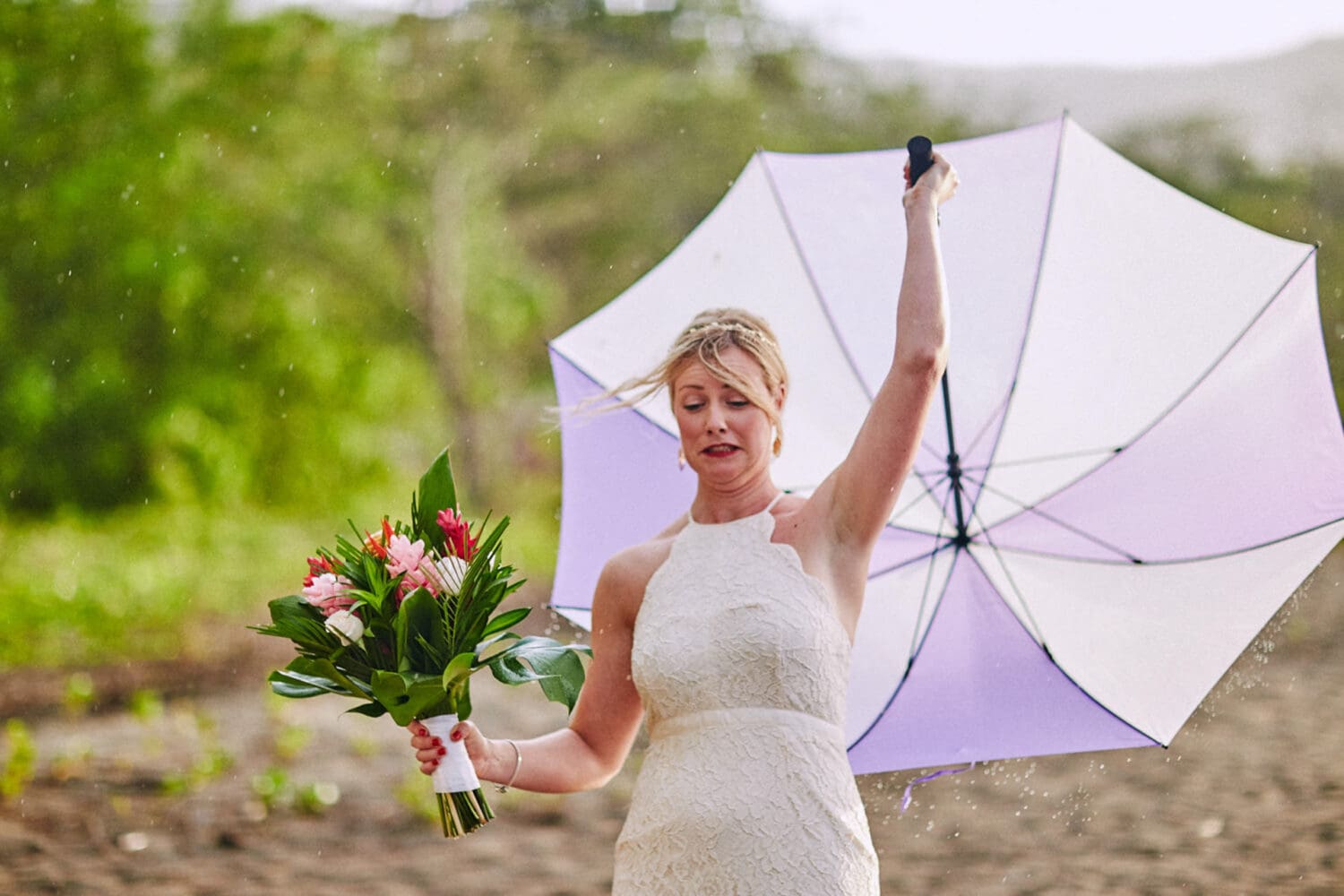
What is Costa Rica’s green season actually like?
Green season is the local name many people use for what is also called the rainy season or wet season. It is roughly May through November. The Costa Rica Green Season Wedding.
The simplest way to understand it is not as “six months of rain,” but as a season with a greater possibility of tropical rainfall and a very different landscape.
A typical Pacific day can develop something like this:
Morning: clearer skies or sunshine.
Late morning: temperatures rise and clouds begin developing.
Afternoon: showers become more likely.
Later afternoon and evening: conditions may improve again.
That is a pattern, not a promise. Some days remain dry. Some storms arrive earlier. Some days bring short showers, while others bring much heavier rain.
The research behind this guide identifies this daily convective cycle as one of the most important things couples misunderstand about green season. Tropical heating drives evaporation and cloud development, which can lead to localized afternoon showers.
So when someone says, “It’s rainy season,” that isn’t enough information to plan a wedding.
You also need to know:
Where?
What month?
What time of day?
What does the venue have available if the weather changes?
What is the veranillo?
If you’re considering July, you may hear the word veranillo, or “little summer.”
It refers to a period of relatively reduced rainfall that can occur during the middle of the green season, particularly along parts of the Pacific slope. It can bring stretches of clearer weather during a season that is generally wetter.
It is one reason I wouldn’t look at the words “green season” and assume that every month behaves the same way.
The same goes for September and October.
Those months can be very wet on parts of the Pacific coast, while the Caribbean coast can experience a very different weather pattern.
This is why Costa Rica wedding weather should always be considered regionally, not just nationally.
Where should you get married during green season?
There isn’t one Costa Rica weather pattern.
The country has several distinct microclimates, and your location can make a major difference.
Guanacaste and the North Pacific
Guanacaste is generally the drier part of the Pacific side of Costa Rica.
During green season, the landscape changes dramatically. The dry tropical forests become much greener, and the contrast between the dry-season landscape and green season can be significant.
For couples who want a beach wedding but are concerned about rain, Guanacaste is an important region to consider.
It is still tropical weather, so rain is possible. But the rainfall pattern is different from the wetter rainforest regions farther south.
Manuel Antonio, Uvita and the South Pacific
The Central and South Pacific receive considerably more rainfall, with rainforest vegetation meeting the ocean.
That can mean more dramatic weather during the wetter months.
It also means an extremely lush environment.
If you are attracted to Costa Rica because you want dense tropical vegetation, waterfalls, jungle and that deep green landscape, this is part of the trade-off.
You’re choosing a landscape that depends on rain.
Arenal and La Fortuna
Arenal has its own volcanic microclimate.
Weather can change around the volcano, and rain is part of what makes the region what it is.
Waterfalls are full.
The rainforest is intensely green.
Mist can become part of the landscape.
For a wedding or elopement here, I wouldn’t approach rain in exactly the same way as I would approach a beach wedding in Guanacaste.
The environment itself is already telling you what kind of place you’re in.
The Caribbean
The Caribbean is one of the reasons you should never make a Costa Rica wedding decision based only on a national “rainy season” calendar.
September and October can be among the wetter months on the Pacific side while the Caribbean coast can experience a much drier period.
So if you’re considering September or October, don’t simply ask:
“Is Costa Rica rainy?”
Ask:
“Which part of Costa Rica?”
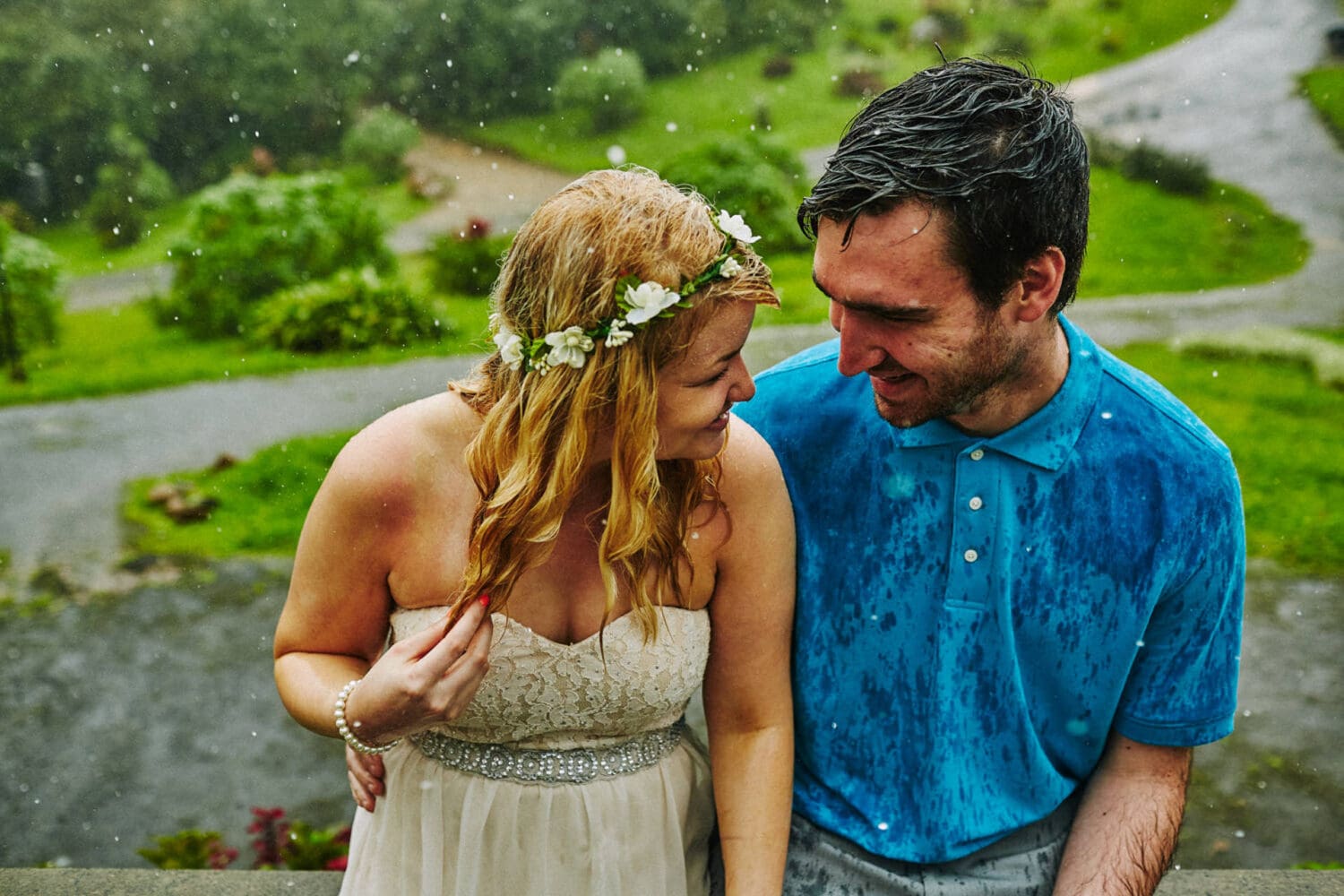
Costa Rica Green season wedding vs. Costa Rica Dry season wedding
The difference isn’t simply “rainy versus sunny.”
It changes the entire visual environment.
| Green Season | Dry Season | |
|---|---|---|
| Rain | Greater possibility of tropical showers | Generally drier |
| Landscape | Lush, saturated vegetation | Drier tropical landscape |
| Light | More cloud cover and softer light | More direct sunshine |
| Planning | Requires more flexibility | More predictable for outdoor events |
| Atmosphere | Tropical, green, sometimes dramatic | Brighter and more consistently sunny |
| Photography | Clouds, wet foliage and post-storm light | Strong sunlight and clear skies |
There isn’t a universal winner here.
If you want guaranteed dry weather, green season involves more uncertainty.
If you love lush vegetation, softer light and don’t mind adapting to weather, green season has something different to offer.
And for photography, that difference can be significant.
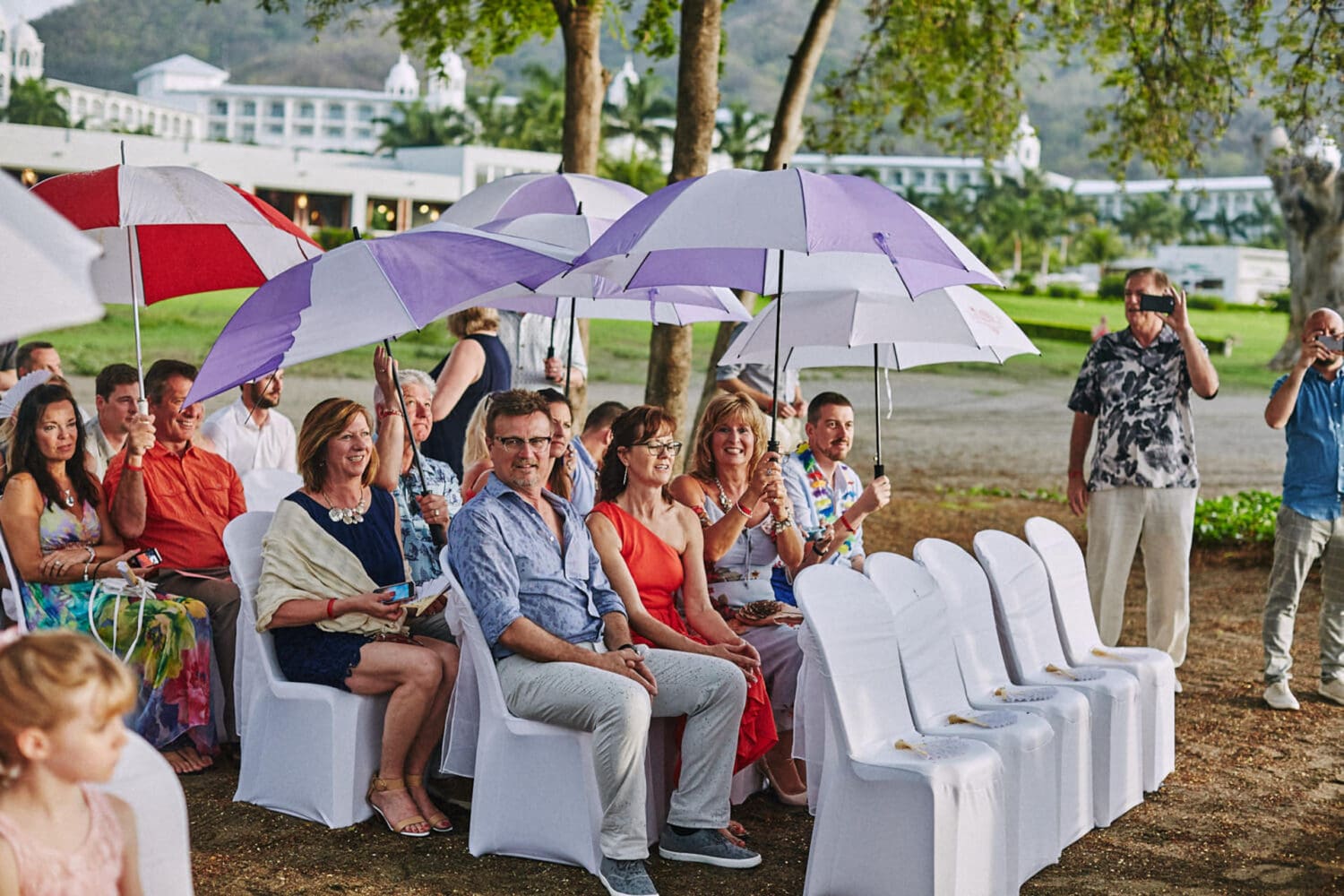
What time should a Costa Rica green season wedding ceremony start?
For a wedding, my preference is usually the sunset hour.
I don’t automatically move a ceremony earlier simply because it’s green season.
My experience is that rain on the Pacific side often develops around noon and through the afternoon, while conditions can clear toward the end of the day.
But there is an important exception.
If there is strong evidence that rain is definitely coming, I would rather move the ceremony a little earlier than gamble with it.
This is where experience matters.
I’m not trying to predict the weather perfectly. I’m trying to make a good decision with the information we have.
Elopements are different
For an elopement, I usually recommend a morning ceremony.
The reason isn’t only weather.
You have the whole day ahead of you.
You can get married in the morning and then spend the rest of the day exploring, hiking, swimming, visiting waterfalls or simply going somewhere beautiful together.
A wedding with 80 guests and an elopement for two people don’t need the same timeline.
What should a Costa Rica wedding rain backup plan look like?
A good Plan B is more than somewhere dry.
It should be somewhere that still allows the wedding to feel like your wedding.
My first choice is usually a tent, particularly when it allows you to stay connected to the landscape rather than suddenly moving everyone into a completely different environment.
If the venue has a small hall that can be prepared without disturbing the rest of the property, that can also work very well.
And in extreme circumstances, the reception space itself can become the ceremony space.
The important thing is not having a theoretical Plan B.
It’s knowing exactly what Plan B is.
Questions to ask your venue about rain
Before booking, ask:
- Where exactly will the ceremony move if it rains?
- Is that space guaranteed for our wedding?
- Can it be prepared quickly?
- Can all our guests fit comfortably?
- What does it look like?
- Does it have natural light?
- Can our photographer work there easily?
- Can the ceremony and reception still flow naturally?
- Who makes the final decision about moving?
- How much notice does the venue need?
A covered space that looks beautiful in photographs is very different from a backup space that simply keeps everyone dry.
Don’t only ask, “Do you have a Plan B?”
Ask to see it.
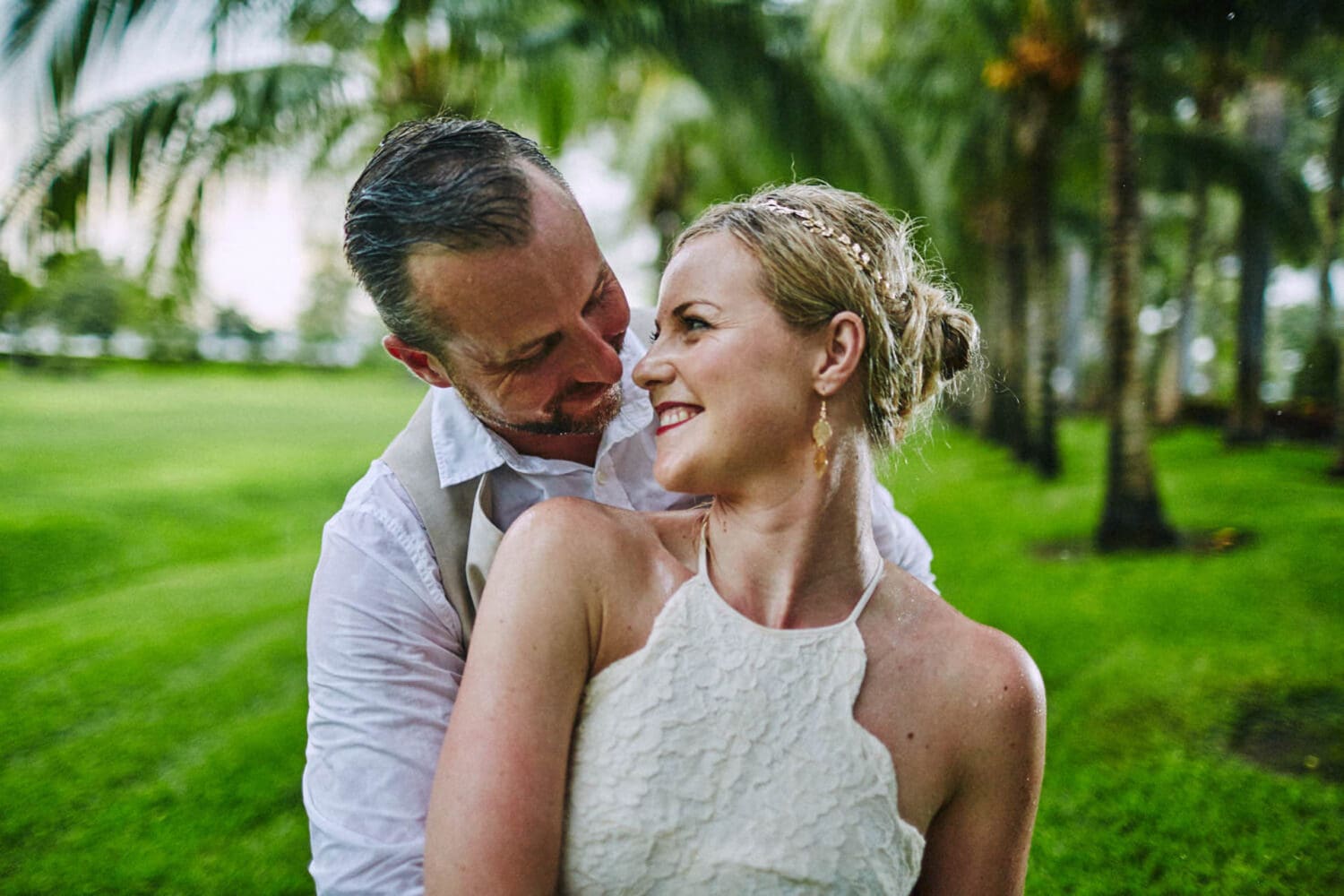
Three Costa Rica venues I’ve seen handle rain well
There are many venues in Costa Rica, and I’m not going to pretend there is one universal list of “best rainy-season venues.”
Instead, here are three places I know from experience that illustrate different approaches.
La Paz Waterfall Gardens
La Paz is a place where rain is simply part of the environment.
They have different options for changing conditions, including kiosks, a salon and tents.
That matters because a venue accustomed to rain doesn’t have to improvise its entire operation when weather changes.
Tabacón Thermal Resort & Spa
Tabacón is also located in a naturally rainy environment.
The important thing from a wedding-planning perspective is that they are accustomed to operating in those conditions.
When you’re considering a green-season wedding, I would rather work with a venue that understands its own weather than one that treats rain as an unusual emergency.
El Mangroove, Papagayo
El Mangroove is another good example for a different reason.
The architecture gives you attractive alternatives if weather means the ceremony needs to move indoors.
That is exactly what I look for in a Plan B.
Not simply:
“Can we fit everyone inside?”
But:
“If we move inside, does the experience still work?”
The biggest mistake couples make during green season
Don’t just have a Plan B. Embrace the possibility of rain.
The biggest mistake I see is not failing to rent enough umbrellas.
It’s not embracing the possibility that rain might happen.
If you’re getting married in Costa Rica, you’re getting married in a tropical country.
Rain is part of the place.
You can prepare for it without spending the entire day hoping it doesn’t happen.
I’ve seen couples become stressed because the first drops appear and everyone immediately starts thinking the wedding is ruined.
But rain doesn’t necessarily mean you need to stop.
Sometimes you continue.
Sometimes you move under cover.
Sometimes you wait.
Sometimes you go outside and get wet.
The decision depends on the couple and the conditions.
What happens when it actually rains at a Costa Rica wedding?
I’ve seen this play out in very different ways.
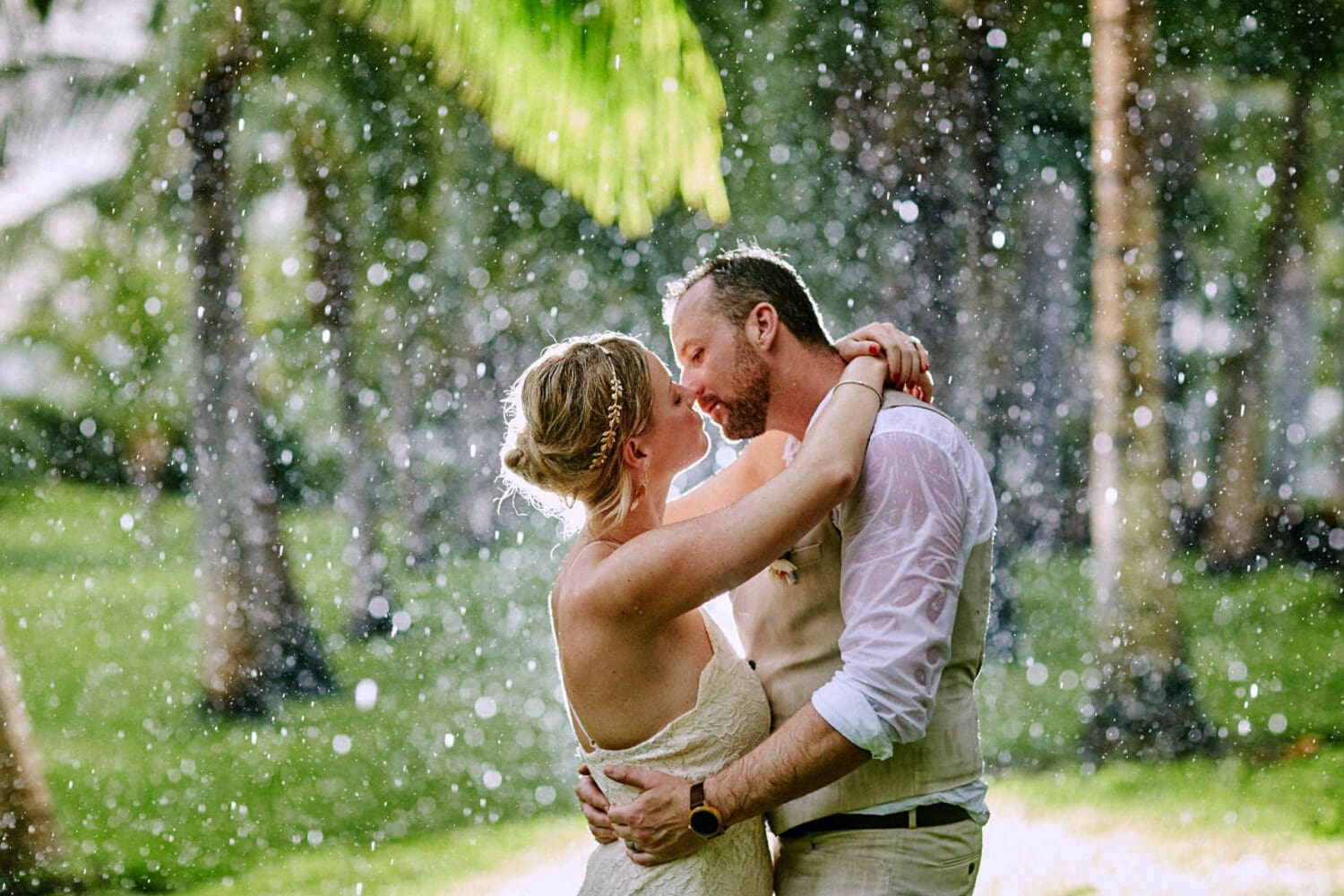
Lauren & Shae: when the rain became part of the wedding
At Lauren and Shae’s wedding at the RIU, everything was ready by the beach.
Then it started raining.
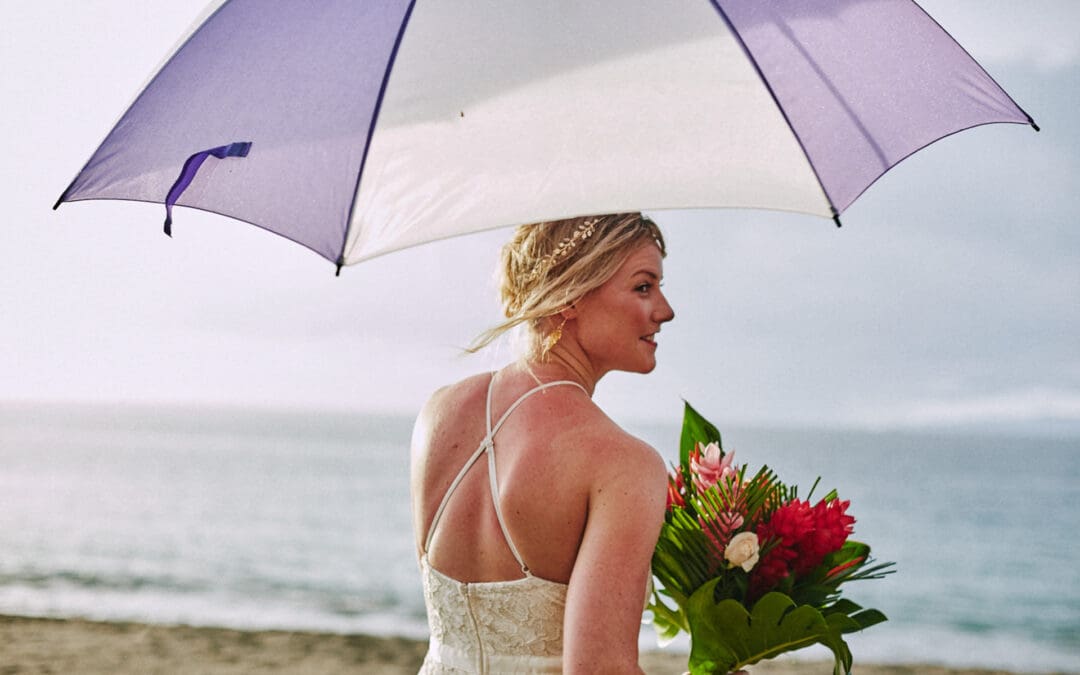
They quickly got umbrellas and continued as if nothing unusual was happening.
They even got into the water.
I photographed them under the rain and used a small flash to make the rain visible behind them.
That’s how we made one of my favorite photographs from the day: the two of them kissing, surrounded by falling rain.
What I remember most, though, was what they told me afterward.
They were happy I wasn’t worried about the weather.
They said it was great having me there because I stayed calm and kept doing the job.
That is something I think is easy to underestimate.
The photographer’s attitude can affect how a couple experiences the weather.
If I look worried, start running around and make the rain feel like an emergency, the couple is going to feel it.
If I stay calm, assess the situation and keep working, they can think:
“Okay. This isn’t the end of the day.”
Kelsey & Tucker: sometimes you should stop
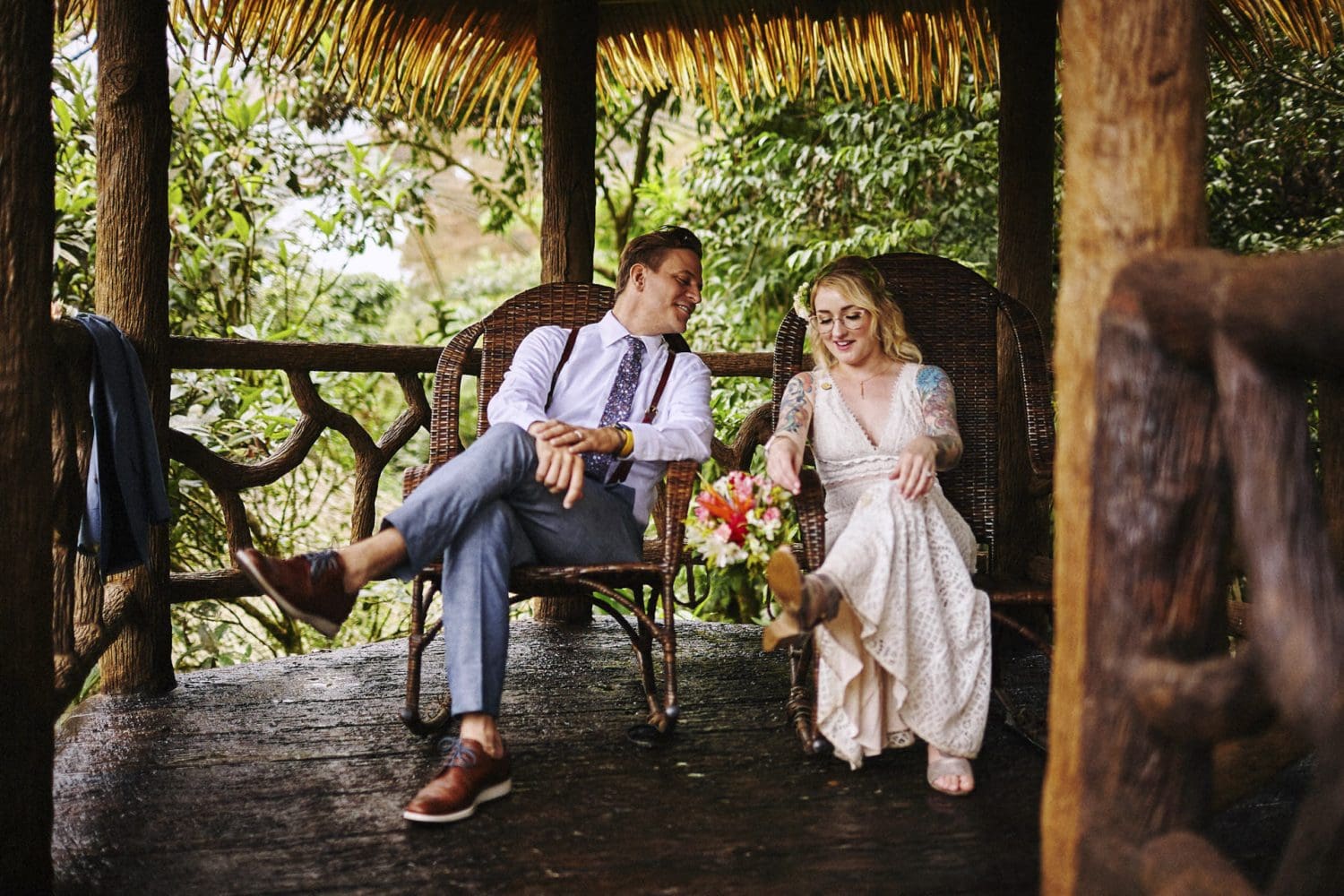
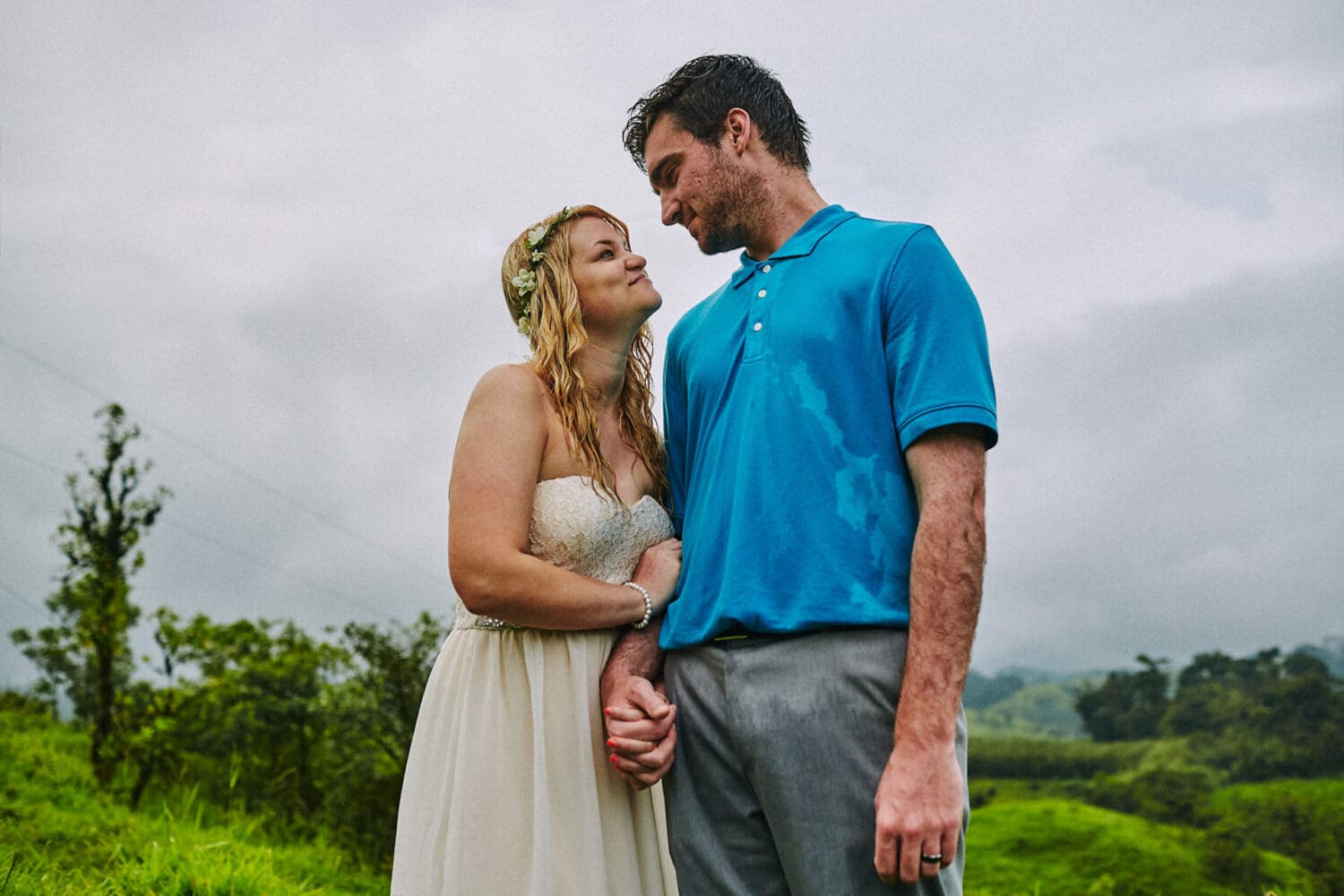
Kelsey and Tucker’s elopement at Villa Blanca was completely different.
The rain became so heavy that we had to stop.
There was no point pretending otherwise.
We waited for a couple of hours.
That changed the schedule. Dinner and some of the later events moved into the evening.
But something interesting happened because of that change.
When we continued, we had blue-hour light.
I combined that light with flash, and we created photographs that belonged to the new version of the day.
They loved the experience.
This is why I don’t tell couples that rain is “never a problem.”
Sometimes it is a problem.
Sometimes the right answer is to wait.
The experience comes from knowing when to keep going and when to stop.
What does a wedding photographer do when rain is coming?
When I arrive at a wedding and see storm clouds building, I don’t immediately tell everyone that a storm is coming.
First, I make sure people are aware of the weather.
I might ask how the weather was the day before.
I look around.
And I start looking for a good indoor location for photographs.
If I find one, I might casually tell the couple:
“I saw this nice place in case we need photos inside.”
That’s it.
I’m not creating panic.
I’m creating an option.
Then I keep watching.
How do you know when rain is coming in Costa Rica?
I’m not a meteorologist, and I’m not pretending that experience lets me predict every storm.
But after years of working here, you learn to pay attention to things beyond an app.
I look at the clouds.
I watch how they’re developing.
And sometimes Costa Rica gives you another little warning.
There can be a breeze just before the rain arrives.
It has a particular smell.
Sometimes you can almost smell the water coming.
Those are small observations, but after doing this for years, they become part of how you work.
A weather forecast can tell me that rain is possible.
Standing at the venue tells me something else.
Should you take wedding photographs in the rain?
Only if you’re comfortable with it.
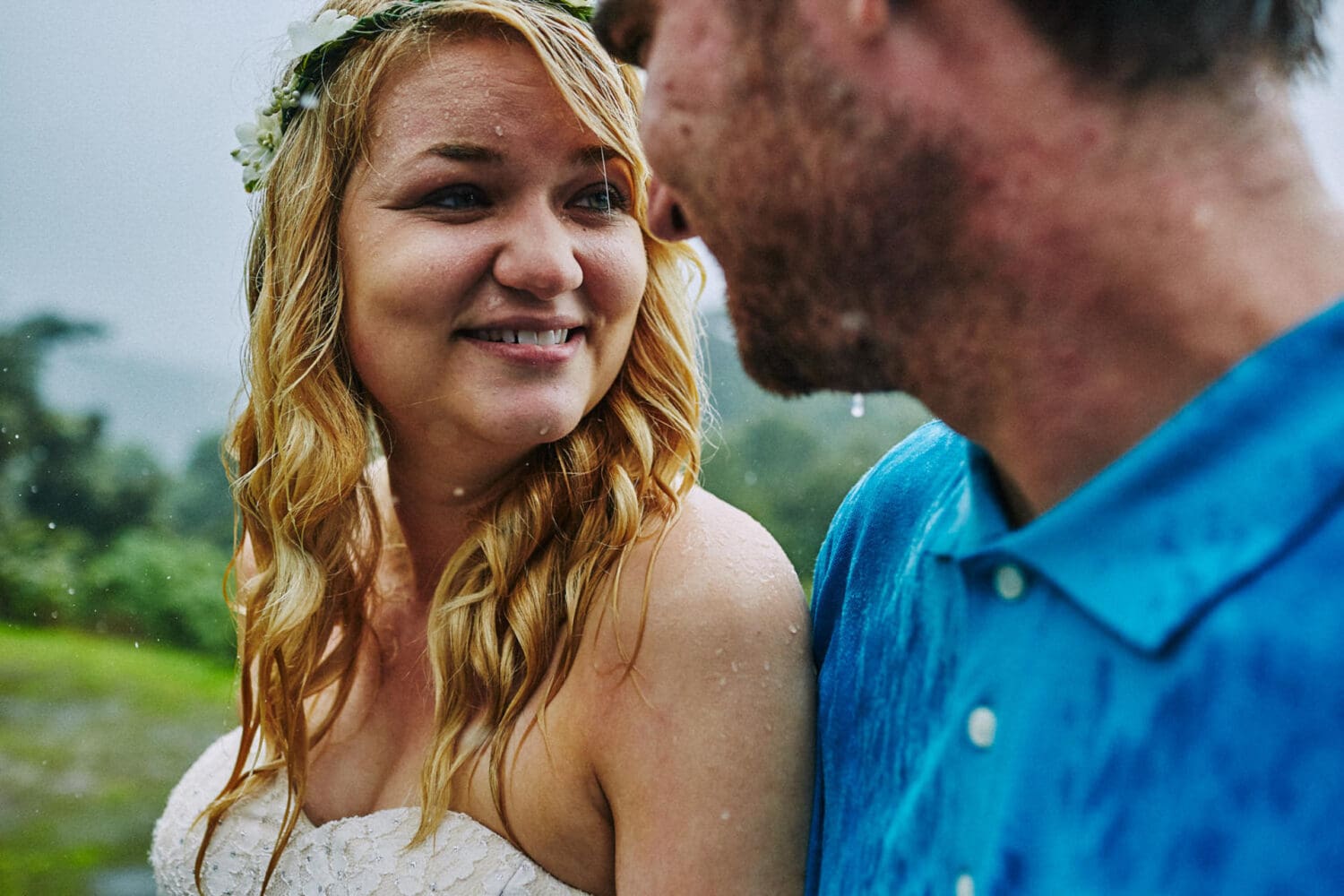
The first thing I ask a couple is how they feel about getting wet.
Do you care if your dress gets wet?
Does the suit matter?
What about your hair and makeup?
Are you comfortable standing in the rain for a few minutes?
There isn’t a correct answer.
If they say:
“We love rain. Let’s do it.”
Great.
Let’s get wet.
We can use umbrellas.
We can use flash.
We can make the rain visible.
We can work with reflections, wet vegetation and whatever the weather is giving us.
If they say:
“Absolutely not. I don’t want my dress or hair getting wet.”
That’s completely fine too.
We stay inside.
We find beautiful scenarios.
We use the architecture.
We work with the available light.
The important thing is:
I never force the couple.
Make them feel great and they will look great in the photographs.
Can rain actually make Costa Rica wedding photos better?
Sometimes, yes.
Not because rain automatically makes every photograph better.
But because it changes the light and the environment.
Cloudy conditions can be very helpful for photography because the light becomes softer and less directional. You can often photograph more comfortably at different hours without fighting strong tropical sunlight.
And the colors can become intense.
Green vegetation becomes more saturated.
Wet surfaces reflect light.
The air can feel different after a storm.
And when the clouds finally break, the light can change very quickly.
That can create some extraordinary moments.
Rain also gives you another photographic tool
With flash, falling rain can become visible in the background.
That’s what I did with Lauren and Shae.
Without the rain, that photograph wouldn’t exist.
With Kelsey and Tucker, waiting for the weather gave us something completely different: blue-hour light combined with flash.
So I don’t think of rain as a photographic effect that you force into every wedding.
I think of it as another condition to work with.
What international wedding photographers often underestimate about Costa Rican rain
The rain can be much stronger than people imagine.
Someone coming from a drier climate can look at a forecast and think they understand what “rain” means.
Tropical rain can be another experience entirely.
I’ve also seen photographers discover that their equipment wasn’t as weather-sealed as they thought it was.
That’s one reason local experience matters.
You need to know when to protect the equipment, when you can continue working, where you can move quickly and how to keep photographing without putting everything at unnecessary risk.
The weather doesn’t care that you have a timeline.
You have to adapt to it.
What 18+ years of weddings have taught me about Costa Rican rain
A weather website can tell you that rain is likely.
It can’t tell you whether you should keep walking toward the ceremony, wait for an hour, move under cover or take the couple outside and let them get wet.
After more than 18 years photographing weddings in Costa Rica, I’ve learned to think quickly when conditions change.
Have a Plan B.
Stay calm.
And then embrace what actually happens.
That last part is important.
Because sometimes the clouds give you softer light.
Sometimes the landscape becomes incredibly saturated.
Sometimes the rain passes and the evening opens up.
Sometimes you get blue hour.
Sometimes you make a photograph that simply couldn’t have existed without the rain.
And sometimes the rain is too heavy and you need to stop.
That’s okay too.
The goal isn’t to control the weather.
The goal is to make sure the weather doesn’t control how you experience your wedding.
Should you take wedding photographs in the rain?
Only if you’re comfortable with it.
The first thing I ask a couple is how they feel about getting wet.
Do you care if your dress gets wet?
Does the suit matter?
What about your hair and makeup?
Are you comfortable standing in the rain for a few minutes?
There isn’t a correct answer.
If they say:
“We love rain. Let’s do it.”
Great.
Let’s get wet.
We can use umbrellas.
We can use flash.
We can make the rain visible.
We can work with reflections, wet vegetation and whatever the weather is giving us.
If they say:
“Absolutely not. I don’t want my dress or hair getting wet.”
That’s completely fine too.
We stay inside.
We find beautiful scenarios.
We use the architecture.
We work with the available light.
The important thing is:
I never force the couple.
Make them feel great and they will look great in the photographs.
Can rain actually make Costa Rica wedding photos better?
Sometimes, yes.
Not because rain automatically makes every photograph better.
But because it changes the light and the environment.
Cloudy conditions can be very helpful for photography because the light becomes softer and less directional. You can often photograph more comfortably at different hours without fighting strong tropical sunlight.
And the colors can become intense.
Green vegetation becomes more saturated.
Wet surfaces reflect light.
The air can feel different after a storm.
And when the clouds finally break, the light can change very quickly.
That can create some extraordinary moments.
Rain also gives you another photographic tool
With flash, falling rain can become visible in the background.
That’s what I did with Lauren and Shae.
Without the rain, that photograph wouldn’t exist.
With Kelsey and Tucker, waiting for the weather gave us something completely different: blue-hour light combined with flash.
So I don’t think of rain as a photographic effect that you force into every wedding.
I think of it as another condition to work with.
What international wedding photographers often underestimate about Costa Rican rain
The rain can be much stronger than people imagine.
Someone coming from a drier climate can look at a forecast and think they understand what “rain” means.
Tropical rain can be another experience entirely.
I’ve also seen photographers discover that their equipment wasn’t as weather-sealed as they thought it was.
That’s one reason local experience matters.
You need to know when to protect the equipment, when you can continue working, where you can move quickly and how to keep photographing without putting everything at unnecessary risk.
The weather doesn’t care that you have a timeline.
You have to adapt to it.
What 18+ years of weddings have taught me about Costa Rican rain
A weather website can tell you that rain is likely.
It can’t tell you whether you should keep walking toward the ceremony, wait for an hour, move under cover or take the couple outside and let them get wet.
After more than 18 years photographing weddings in Costa Rica, I’ve learned to think quickly when conditions change.
Have a Plan B.
Stay calm.
And then embrace what actually happens.
That last part is important.
Because sometimes the clouds give you softer light.
Sometimes the landscape becomes incredibly saturated.
Sometimes the rain passes and the evening opens up.
Sometimes you get blue hour.
Sometimes you make a photograph that simply couldn’t have existed without the rain.
And sometimes the rain is too heavy and you need to stop.
That’s okay too.
The goal isn’t to control the weather.
The goal is to make sure the weather doesn’t control how you experience your wedding.
Costa Rica Green Season Wedding FAQs
Does it rain all day during Costa Rica’s green season?
No. Green season means a greater likelihood of rainfall, not continuous rain every day. On parts of the Pacific coast, rain often develops later in the day, although conditions vary by location and date.
Is green season a bad time for a Costa Rica wedding?
Not necessarily. It depends on how comfortable you are with weather flexibility, where in Costa Rica you’re getting married and how well the venue handles rain.
What time should a green-season wedding ceremony start?
For a wedding, I generally prefer the sunset hour. If there is strong evidence that rain is likely to arrive around that time, I would consider moving the ceremony earlier. For elopements, I generally prefer a morning ceremony so the couple has the rest of the day for their adventure.
What happens if it rains during an outdoor wedding ceremony?
You have several options. Continue under a tent or covered space, move indoors, or wait for the rain to pass. The right decision depends on the intensity of the rain, the venue and how comfortable the couple is.
Should I have a tent for a Costa Rica wedding?
A tent can be an excellent Plan B, particularly when it allows you to remain connected to the outdoor environment. But ask your venue exactly what the tent setup involves before booking.
Can you take wedding photographs in heavy rain?
Sometimes. If the couple is comfortable getting wet and the conditions are safe, rain can become part of the photographs. If the rain is too heavy, waiting can be the better choice.
Can rain make wedding photographs better?
It can. Cloudy conditions can produce softer light, while rain can saturate vegetation and create reflections. Flash can also make falling rain visible in the frame. The key is working with the conditions rather than forcing a particular effect.
Is September or October a good time for a Costa Rica wedding?
It depends heavily on the region. These months can be among the wettest on the Pacific side, while the Caribbean can experience a much drier period.
What is the veranillo?
The veranillo, or “little summer,” is a period of relatively reduced rainfall that can occur during the middle of the green season, particularly on parts of the Pacific slope.
What should I ask a Costa Rica wedding photographer about rain?
Ask whether they have photographed real weddings during heavy rain, how they approach a changing timeline, what happens if you need to move indoors and whether they are comfortable photographing in the conditions you’re likely to encounter.
Planning a Costa Rica wedding during green season?
You don’t need to hope for perfect weather.
You need a good plan, a flexible timeline and people who know what to do when the weather changes.
And if the rain comes?
Sometimes we’ll stay inside.
Sometimes we’ll wait.
And sometimes we’ll go outside and make photographs in it.
That’s part of getting married in Costa Rica.